The Real Silent Killer
What Is "pH"?
The body is largely made up of water, a medium which is
biologically useful in allowing nutrients, oxygen and biochemicals to be
transported from place to place. This water-based medium can have either
acid or alkaline properties which are measured by a graduated scale
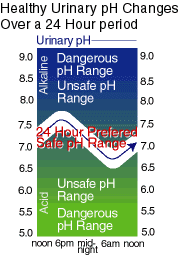
called pH (for "potential hydrogen"), wherein 1.0 to 6.9 is
considered acidic, 7.0 is neutral, and 7.1 to 14.0 is alkaline. The
lower the pH number, the greater the acidity, and the higher the pH
number, the greater the alkalinity.
Why Should I Be Concerned
About My pH Levels?
 Since
most of the body is water-based (making up 50-60% of our total body
weight), the pH level has profound effects on all body chemistry, health
and disease. An imbalanced pH describes the pH level of the body when it
becomes too acidic or too alkaline for long periods of time. Extended pH
imbalances of any kind are not well tolerated by the body. Indeed, the
management of "pH" is so important that the body has developed
strict accounting procedures to monitor acid-alkaline balances in every
cell. Fundamentally, all regulatory mechanisms (including breathing,
circulation, digestion, hormonal production, etc.) serve the purpose of
balancing pH, by removing caustic metabolized acid residues from body
tissues without damaging living cells. If the pH deviates too far to the
acid side or too far to the alkaline side, cells become poisoned by
their own toxic waste and die. Since
most of the body is water-based (making up 50-60% of our total body
weight), the pH level has profound effects on all body chemistry, health
and disease. An imbalanced pH describes the pH level of the body when it
becomes too acidic or too alkaline for long periods of time. Extended pH
imbalances of any kind are not well tolerated by the body. Indeed, the
management of "pH" is so important that the body has developed
strict accounting procedures to monitor acid-alkaline balances in every
cell. Fundamentally, all regulatory mechanisms (including breathing,
circulation, digestion, hormonal production, etc.) serve the purpose of
balancing pH, by removing caustic metabolized acid residues from body
tissues without damaging living cells. If the pH deviates too far to the
acid side or too far to the alkaline side, cells become poisoned by
their own toxic waste and die.
Is An Imbalanced Body pH Really That
Dangerous?
Yes, indeed it is! Nothing does well in an overly acidic
or alkaline pH medium, least of all the human body! Just as acid rain
can destroy a forest and alkaline wastes can pollute a lake, an
imbalanced pH continuously corrodes all body tissue, slowly eating into
the 60,000 miles of our veins and arteries like corrosives eating into
marble. If left unchecked, an imbalanced pH will interrupt all cellular
activities and functions, from the beating of your heart to the neural
firing of your brain... An imbalanced pH interferes with all life
itself! ^Top^
Can
An Imbalanced pH Cause Serious Problems?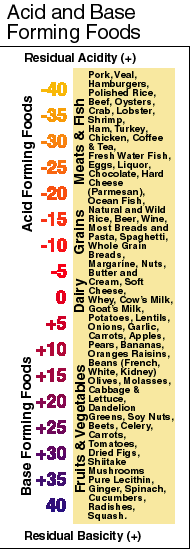
Yes, especially as a person grows older! Although it may
generally go unnoticed and undetected for years, an imbalanced pH
(either consistently too acid or alkaline) leads to the progression of
most, if not all, degenerative diseases including Cardiovascular Disease
(the #1 killer in the U.S.), Cancer (the #2 Killer in the U.S.), and
Diabetes, as well as the never ending frustration of excessive systemic
weight gain. The U.S. National Center for Health Statistics estimates
that if Cardiovascular Disease alone could be eliminated, it would add
an average of 9.78 years to our life span! That's almost 10 years of
additional life per person!
What Causes pH to Become Imbalanced?
Most diets cause an unhealthy Acid pH. In fact, diet
appears to be the major influence in maintaining appropriate pH levels
throughout the body. Research demonstrates that when food is metabolized
and broken down, it leaves certain chemical and metallic residues, a
noncombustible "ash" which, when combined with our body
fluids, yields either acid or alkali potentials of pH. Certain foods are
"acid-forming" in nature, whereas others are known to be
"alkali-forming."
^Top^
Which Foods Are "Acid-Forming" And
Which Ones Are "Alkaline-Forming"?
Most high protein foods (such as meat, fish, poultry and
eggs), nearly all carbohydrates (including grains, breads and pastas)
and fats are "acid-forming." And most fruits and vegetables
are "alkaline-forming." Although citrus fruits, such as
oranges and grapefruit, contain organic acids and may have an acid
taste, they are not acid-forming when metabolized, leaving no acidic
residue. Similarly, Free Form Amino Acids are not acid-forming, but
instead offer unique buffering capabilities to the body to help offset
acidic wastes.
How Do I Rebalance My pH?
Watching your diet can help. If you're too acid, increase
the number of fruits and vegetables you eat. If you're too alkaline,
increase the amounts of acid-forming foods consumed. But an easier way
is to take Ericsson's AlkaMine Coral Calcium
and consume 1.5 to 3 liters of water treated with Coral Calcium daily.
|

